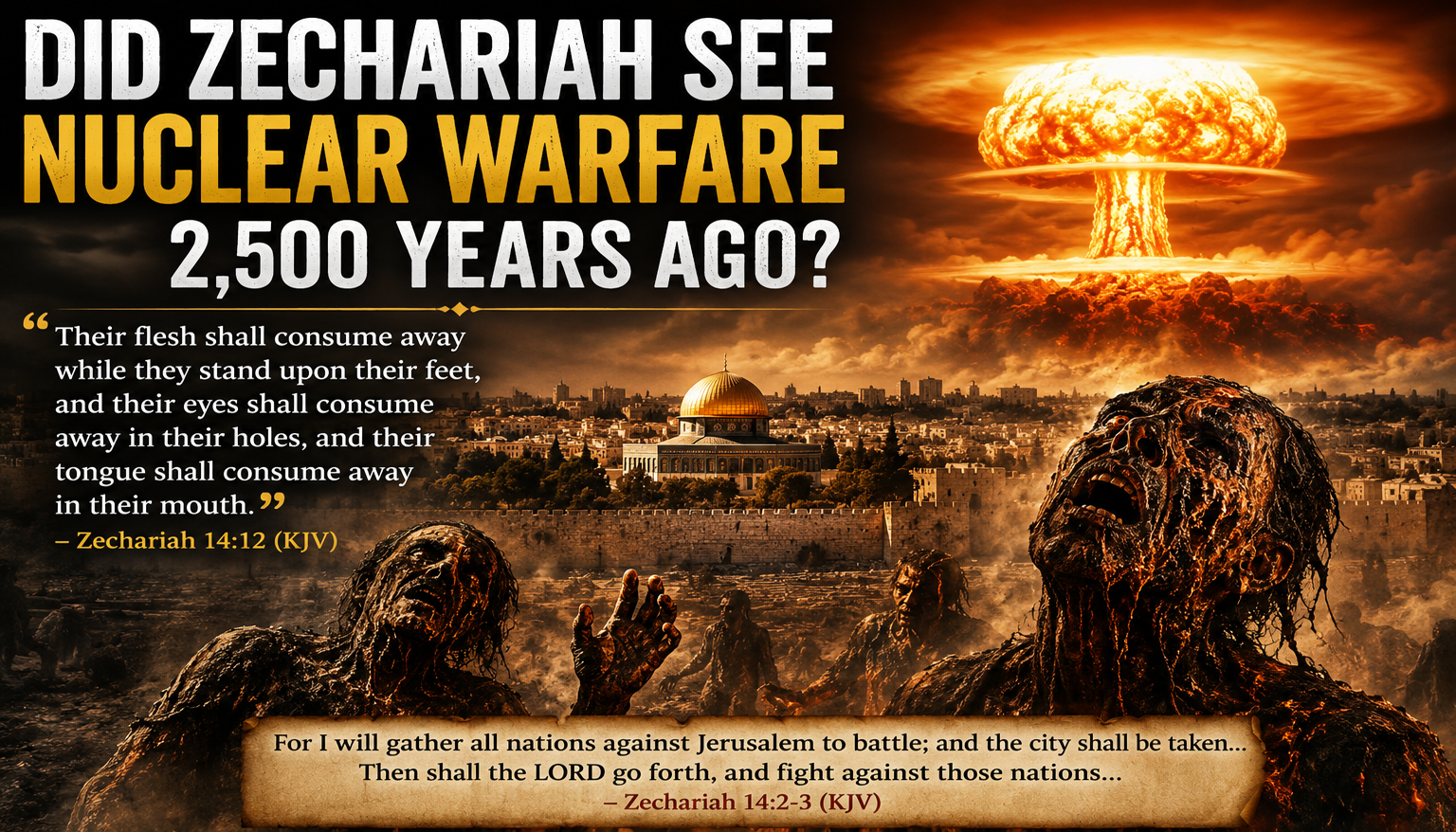
Did Zechariah See Nuclear Warfare 2,500 Years Ago?
Zechariah 14:12 (KJV) — “And this shall be the plague wherewith the LORD will smite all the people that have fought against Jerusalem; Their flesh shall consume away while they stand upon their feet, and their eyes shall consume away in their holes, and their tongue shall consume away in their mouth.”
E6
Did Zechariah See Nuclear Warfare 2,500 Years Ago?
The prophet Zechariah recorded one of the most disturbing descriptions of judgment found anywhere in the Bible. Written more than two thousand years before the invention of nuclear weapons, the passage describes people standing upon their feet while their flesh consumes away, their eyes consume away in their sockets, and their tongues consume away in their mouths.
For generations, readers could only imagine what such an event might look like. Today, however, humanity possesses weapons capable of producing extraordinary heat and destruction within seconds. This raises an intriguing question: Could Zechariah have been describing something resembling nuclear warfare without having the vocabulary to explain what he was seeing?
Zechariah's Terrifying Prophecy
Zechariah 14 describes a future conflict centered upon Jerusalem. Nations gather against the city, followed by the intervention and judgment of God.
Zechariah 14:12 (KJV) — “And this shall be the plague wherewith the LORD will smite all the people that have fought against Jerusalem; Their flesh shall consume away while they stand upon their feet, and their eyes shall consume away in their holes, and their tongue shall consume away in their mouth.”
The description is extraordinary. People are apparently still standing while their bodies are being destroyed. Their flesh, eyes, and tongues are specifically mentioned. Zechariah does not tell us about missiles, bombs, radiation, or explosions. He simply records what happens to the people.
That distinction may be important. Zechariah describes the result, but he does not tell us what physical mechanism produces it.
How Would an Ancient Prophet Describe Modern Warfare?
Suppose for a moment that a person living approximately 2,500 years ago were shown a vision of a modern nuclear attack. How could he possibly describe what he was seeing?
He would have no words for an intercontinental ballistic missile. He wouldn't know what uranium or plutonium were. Terms such as nuclear fission, radiation, thermal pulse, shock wave, and radioactive fallout would have been completely unknown to him.
He could only describe what he saw happening. That possibility makes Zechariah 14:12 particularly fascinating. Rather than explaining the technology responsible for the destruction, Zechariah describes its effects upon human beings.
Why Some Compare This Passage to Nuclear Weapons
A nuclear explosion produces several devastating effects, including an enormous blast wave, intense thermal radiation, and ionizing radiation. The thermal energy released by a nuclear explosion can cause catastrophic burns, while the intense flash can cause severe eye injuries.
Because Zechariah specifically describes flesh, eyes, and tongues being consumed, some students of Bible prophecy have wondered whether the prophet could have been witnessing the effects of a weapon completely beyond the understanding of his time.
The comparison is certainly thought-provoking. However, similarities are not proof. The Bible never uses the words “nuclear weapon,” nor does Zechariah explain the scientific process responsible for what he witnesses.
Could God Use Human Weapons to Carry Out Judgment?
Some might point out that Zechariah specifically says that “the LORD will smite all the people that have fought against Jerusalem.” Wouldn't that mean the destruction must come directly and supernaturally from God?
Not necessarily. Throughout Scripture, God sometimes uses nations, rulers, and armies as instruments through which His judgment is carried out. One particularly clear example involves the ancient Assyrian Empire.
Isaiah 10:5 (KJV) — “O Assyrian, the rod of mine anger, and the staff in their hand is mine indignation.”
Assyria was a real human empire with real soldiers and real weapons. Yet Scripture describes Assyria as an instrument of God's judgment. This establishes an important biblical principle: God's judgment and human military action are not necessarily mutually exclusive.
Therefore, even though Zechariah attributes this future judgment to the LORD, that alone does not tell us whether the physical means will be entirely supernatural or whether human warfare could somehow be involved. If God has used human armies as instruments of judgment before, it is at least possible that human weapons could play a role in future events as well.
The Nations Gather Against Jerusalem
The larger context of Zechariah 14 makes the prophecy even more significant. This isn't an isolated plague occurring without explanation. It happens within a prophecy concerning nations gathering against Jerusalem.
Zechariah 14:2 (KJV) — “For I will gather all nations against Jerusalem to battle; and the city shall be taken…”
Then something dramatic happens. God intervenes.
Zechariah 14:3-4 (KJV) — “Then shall the LORD go forth, and fight against those nations, as when he fought in the day of battle. And his feet shall stand in that day upon the mount of Olives…”
This is why many Christians understand Zechariah 14 as being connected with the return of Jesus Christ and the final conflicts surrounding Jerusalem.
Zechariah and Revelation
The Book of Revelation also describes the nations and their armies gathering for a final confrontation. The similarities between these passages have caused Bible students to examine Zechariah and Revelation together.
Revelation 16:16 (KJV) — “And he gathered them together into a place called in the Hebrew tongue Armageddon.”
Later, Revelation describes the kings of the earth and their armies gathered together as Christ returns.
Revelation 19:19 (KJV) — “And I saw the beast, and the kings of the earth, and their armies, gathered together to make war against him that sat on the horse, and against his army.”
Whether these passages describe precisely the same moment is debated among Bible scholars, but the parallels are difficult to ignore: Jerusalem, gathering nations, enormous military conflict, divine intervention, and the ultimate defeat of those opposing God.
A World Now Capable of Unimaginable Destruction
For most of human history, mankind did not possess weapons capable of destroying an entire city almost instantly. That changed in the twentieth century with the development of nuclear weapons.
Today, humanity possesses weapons powerful enough to cause destruction on a scale that ancient generations could scarcely have imagined. A nuclear exchange involving modern weapons could produce devastation far beyond anything available to the armies of Zechariah's day.
This does not prove that nuclear weapons fulfill Zechariah 14:12. But it does demonstrate something remarkable: a description that might once have seemed almost impossible to imagine can now be compared with destructive forces that actually exist.
Did Zechariah See a Nuclear Weapon?
So was Zechariah actually describing nuclear warfare? The most accurate answer is that it is possible, but Scripture does not tell us with certainty.
Zechariah could be describing a supernatural judgment directly from God. He could be describing a plague or phenomenon unknown to us. He could be describing destruction involving future human warfare. And it remains possible that nuclear weapons — or perhaps something even more destructive — could play a role.
What we should not do is turn “could” into “must.” The prophecy tells us the result but does not identify the mechanism.
The Greater Message of Zechariah
There is also a danger in becoming so focused on identifying the weapon that we overlook the central message of the prophecy. Zechariah isn't primarily giving humanity a lesson about future military technology. He is warning about a coming day when the nations of the world will find themselves in opposition to God.
The chapter ultimately points beyond destruction toward the reign of the LORD.
Zechariah 14:9 (KJV) — “And the LORD shall be king over all the earth: in that day shall there be one LORD, and his name one.”
Whether Zechariah witnessed something resembling nuclear warfare, a supernatural plague, or something mankind has yet to encounter, the ultimate message remains unchanged. Human power will not have the final word. God will.

 E6
E6 
Comments