1. The Seven Sacraments — A Tradition, Not a Command from God
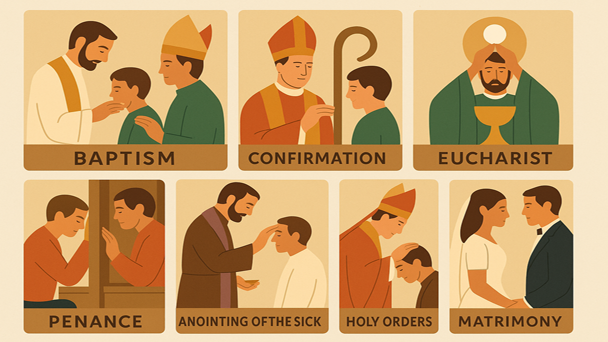
The Catholic Church teaches that salvation and divine grace flow through seven sacraments: Baptism, Confirmation, Eucharist, Penance, Anointing of the Sick, Holy Orders, and Matrimony. These are said to be sacred rituals through which God’s grace is received. However, when compared to Scripture, this system of sacraments cannot be found in the Word of God. It was developed centuries after the time of Christ — through man-made tradition, not divine instruction.
2. The Origin of the Seven Sacraments
The idea of seven sacraments was officially established by the Catholic Church during the Council of Trent (1545–1563). Before that, even Catholic theologians disagreed on how many sacraments existed. Nowhere in Scripture does God or the apostles list seven sacred rituals or declare that grace is distributed through a church system. The Bible makes it clear that grace is a free gift from God through faith in Jesus Christ alone.
KJV Scripture: “For by grace are ye saved through faith; and that not of yourselves: it is the gift of God: not of works, lest any man should boast.” — Ephesians 2:8–9
3. Baptism — Symbol of Faith, Not Salvation
The Catholic Church teaches that baptism washes away original sin and makes one a child of God. The Bible, however, shows that baptism is an outward sign of an inward faith — not the means of salvation.
KJV Scripture: “He that believeth and is baptized shall be saved; but he that believeth not shall be damned.” — Mark 16:16
Notice that belief comes first. Salvation comes by faith; baptism is the public declaration of that faith. Infant baptism, as practiced by Catholicism, has no biblical basis whatsoever.
4. Confirmation — A Human Addition
Confirmation is said to strengthen a believer with the Holy Spirit through the laying on of hands by a bishop. Yet nowhere does Scripture mention a second ceremony to receive the Holy Spirit. The Holy Spirit enters a believer immediately upon salvation.
KJV Scripture: “In whom ye also trusted, after that ye heard the word of truth, the gospel of your salvation: in whom also after that ye believed, ye were sealed with that holy Spirit of promise.” — Ephesians 1:13
Faith in Christ, not a ritual, brings the indwelling of the Holy Spirit.
5. Eucharist — Not a Repeated Sacrifice
The Catholic Eucharist claims to be the literal body and blood of Christ, offered repeatedly at every Mass. But the Bible declares that Jesus’ sacrifice on the cross was a one-time, finished act that never needs repeating.
KJV Scripture: “But this man, after he had offered one sacrifice for sins for ever, sat down on the right hand of God.” — Hebrews 10:12
The Lord’s Supper is a remembrance of His sacrifice, not a continuation of it.
6. Penance — Confession to God, Not to Man
Catholics are taught to confess sins to a priest for forgiveness. Yet the Bible is clear that forgiveness comes only from God, through Jesus Christ.
KJV Scripture: “If we confess our sins, he is faithful and just to forgive us our sins, and to cleanse us from all unrighteousness.” — 1 John 1:9
There is no human mediator between God and man except Jesus (1 Timothy 2:5).
7. Anointing of the Sick — Misapplied Scripture
The Catholic sacrament of anointing the sick (formerly “extreme unction”) is believed to remove sin before death. James 5:14–15 does speak of praying for the sick, but the passage refers to physical healing, not preparing a soul for eternity. Salvation is not given through oil or prayer by clergy but by trusting Christ alone.
8. Holy Orders — The Priesthood of All Believers
The Catholic Church claims its priests have special authority to administer grace and forgiveness. But Scripture teaches that all who are born again are priests before God.
KJV Scripture: “But ye are a chosen generation, a royal priesthood, an holy nation.” — 1 Peter 2:9
There is no separate priestly class in the New Testament Church — Christ alone is our High Priest.
9. Matrimony — A Gift, Not a Sacrament
Marriage is honorable and ordained by God, but nowhere is it presented as a means of receiving grace or salvation. It is a covenant between one man and one woman, blessed by God but not sacramental.
KJV Scripture: “Marriage is honourable in all, and the bed undefiled.” — Hebrews 13:4
The Catholic elevation of marriage to a sacrament adds unnecessary spiritual weight to what God created as a natural, holy union.
10. The Truth — Salvation Is Through Christ Alone
The seven sacraments are man’s attempt to control the flow of grace, placing salvation under the authority of the Church instead of Christ. The Bible never teaches such a system. Grace is not earned, bought, or distributed by clergy — it is freely given by God through faith in His Son.
KJV Scripture: “Therefore being justified by faith, we have peace with God through our Lord Jesus Christ.” — Romans 5:1
Religion complicates what Jesus made simple: “Believe on the Lord Jesus Christ, and thou shalt be saved.” — Acts 16:31
11. Conclusion
The seven sacraments are not biblical commands — they are human traditions that have deceived millions into thinking salvation can be earned or managed through rituals. The Word of God stands alone as truth. We are saved by grace through faith, not by ceremonies or religious systems. Jesus Christ finished the work — and all who trust in Him are complete.

 C37
C37 
Comments